Thursday, October 22, 2015

What would Ike want? His farm provides hints -- Oct. 22, 2015 column

By MARSHA MERCER

At home on their farm in Pennsylvania, Dwight D. “Ike” Eisenhower and his wife Mamie, like millions of other Americans in the 1960s, ate their supper on TV trays, watching Walter Cronkite.

Ike painted in oils, practiced his golf swing and read. Mamie devotedly watched soap operas.

With nearly all the original furnishings still in place, their home tells us that the Eisenhowers had modest tastes and traditional values. There are many framed family photos and knickknacks Mamie collected. But there’s no glory wall of pictures of Ike with kings and potentates, no medals, no political paraphernalia.

Ike was a five-star general, the Supreme Commander of Allied Forces in Europe in World War II and a two-term president from 1953 to 1961, but he hated self-glorification and showing off.
  
The Eisenhowers donated their farm adjacent to the Gettysburg Battlefield to the National Park Service, which opened it to the public in 1980 as the Eisenhower National Historic Site, a fitting memorial to the 34th president.

It should be obvious that a memorial to Eisenhower in the nation’s capital should also reflect his values, but nothing is simple in Washington. 

Congress approved a memorial in 1999, three decades after Ike’s death, and about $65 million of taxpayers’ money has been spent so far on a design, Eisenhower Memorial Commission staff and K Street offices, and other costs. The total pricetag is $142 million.

The first spade of dirt has still not been turned – fortunately. That means there’s still time to get the memorial right.

On the 125th anniversary of Ike’s birth – he was born Oct. 14, 1890 – Congress should stand with critics, including the Eisenhower family, who find the memorial designed by celebrated architect Frank Gehry too grandiose and expensive.

“I think what the critics want is a memorial that’s reflective of Ike’s humility and modesty – and that is not Frank Gehry’s four-acre behemoth,” Bruce Cole, an art historian and a member of the Eisenhower Memorial Commission appointed by President Obama, said in an interview.

“I would like to see a fitting and proper memorial,” Cole said.

I agree, especially after visiting the Eisenhower Farm a few days ago.

Gehry’s latest design has a seven-story stainless steel screen or “tapestry” as a backdrop to two sets of bronze sculptures in front of huge stone blocks, topped by quotations. The location is an urban park adjacent to the Education Department and other federal office buildings at the foot of Capitol Hill, off the National Mall.
 
Because of the design controversy, Congress has not approved construction money for the memorial since 2012. The Senate Appropriations Committee, citing “significant unresolved issues,” approved just $1 million for the project for the next fiscal year, the same as last year. The House Appropriations Committee zeroed out all funding and urged a “reset,” a new design that meets the approval of the Eisenhower family.

Ike’s son John S. D. Eisenhower asked in 2012 that the commission scrap the Gehry design and build instead on Eisenhower Square, “a green, open space with a simple statue in the middle, and quotations.” He died in 2013, and Ike’s grandchildren have been lobbying Congress for a more respectful memorial.

Former Sen. Bob Dole of Kansas, 92, who was wounded in World War II, said last month that he will raise $150 million in private funds to build the memorial.

“This is not being built for the grandchildren,” Dole told The New York Times. “The voice that hasn’t been listened to is us guys for whom Ike was our hero, and we’d like to be around for the dedication.”

Only about one million World War II vets are still with us and fewer Americans every year remember Ike. Last year, 58,240 people visited the Eisenhower Farm, down from 182,387 visitors in 1981.

Dole raised $170 million for the World War II Memorial, but Eisenhower Commission member Cole predicts that “it’s going to be extremely difficult to raise money for the Gehry design, which has been so controversial and toxic since it was unveiled.”

The Eisenhower Memorial should be appropriate for Ike, restrained and dignified. It’s time for a reset.

©2015 Marsha Mercer. All rights reserved.

30

Tuesday, October 20, 2015

On sorting out the possible impact of insurance mergers -- from news.usc.edu

SOURCE: Schaeffer Center at the University of Southern California --    http://bit.ly/1MBERBn

Health policy expert weighs in on insurance mergers at Senate hearing

USC Price public policy director Paul Ginsburg aims to broaden the discussion, thinking of ways to make insurance markets more competitive

U.S. Senate panel
A U.S. Senate panel convenes on health insurance mergers in Washington, D.C. (Photo/Paul Morigi)
Testifying before a U.S. Senate panel, USC health policy expert Paul Ginsburg said that health insurance mega-mergers such as those sought by Aetna and Anthem are extremely complex, difficult to analyze and could cost consumers.
Ginsburg spoke before lawmakers from the Senate Committee on the Judiciary’s Subcommittee on Antitrust, Competition Policy and Consumer Rights Sept. 22. Joining Ginsburg as witnesses were Mark Bertolini, chairman and CEO of Aetna Inc.; Joseph Swedish, president and CEO of Anthem Inc.; Leemore Dafny, research professor in hospital and health services at Northwestern University; Richard Pollack, president and CEO of the American Hospitals Association; and George Slover, senior policy counsel at Consumers Union.

Will consumers save?

For more than two decades, Ginsburg has studied how changes in the financing and delivery of health care affect people. Explaining why the health insurance market is so complex, he said insurers sell to different market segments, including individuals, Medicare beneficiaries and national corporations — in many distinct geographic areas. Additionally, the companies act as intermediaries, buying from health providers and selling insurance to consumers.
Ginsburg acknowledged potential upsides.
“For one, Wall Street analysts believe that these mergers will lead to substantial reductions in administrative costs,” he said.
But will consumers see those savings in their premiums?
Paul Ginsburg testifies
Paul Ginsburg, center, testifies at a Senate hearing. (Photo/Paul Morigi)
“We may believe that a merger will lower prices paid to providers, but we then need to analyze whether fees will be passed on to those buying insurance,” he said.
Chief executives of the insurance companies assured the Judiciary Committee’s antitrust subcommittee that consumers will win from the proposed mergers.
“Better health insurance to more people,” said Swedish, whose company Anthem wants to acquire Cigna for $48 billion.
He and Bertolini, CEO of Aetna, which has agreed to buy Humana and its huge Medicare Advantage business for $37 billion, insisted that fewer, bigger insurance companies will expand competition, improve health care and lower prices.
When asked to assess the Affordable Care Act’s impact on the mergers, Ginsburg said the provisions that do come into play “should be seen in a positive light,” even if they contribute to the urge to merge. The ACA encourages insurers to become more efficient and spurs experimentation in methods of payment, moving away from the traditional fee-for-service model.
Ginsburg is director of public policy at the Leonard D. Schaeffer Center for Health Policy and Economics and is holder of the Norman Topping Chair in Medicine and Public Policy at the USC Price School of Public Policy. An economist, he founded the Center for Studying Health System Change and served as president from 1995 to 2013.

The ultimate arbiter

The Department of Justice — not Congress — ultimately will decide whether to allow the insurance deals. It will conduct a detailed analysis of the possible effects of the mergers and may require the firms to divest some operations, as Anthem had to do in 2012 before buying Amerigroup. The department holds this data private.
“Without being privy to this analysis, I do not have a position concerning whether or not these mergers should be approved,” Ginsburg said. He and Dafny both said they wished the data would be made public.
Given the significance of the insurance sector to our wallets and to the functioning of our health care system, the public deserves better data.
Leemore Dafny
“Given the significance of the insurance sector to our wallets and to the functioning of our health care system, the public deserves better data,” Dafny said.
The antitrust subcommittee rarely tackles health issues, but subcommittee chairman Sen. Mike Lee (R-Utah) said he called the hearing to help the public and lawmakers understand the consolidation trend in the health care industry and how it may affect consumers.

Steep stakes

How the mergers may affect the 90 million people — three out of 10 Americans — who have insurance through the four companies was on the mind of Sen. Amy Klobuchar (D-Minn.), the top Democrat on the subcommittee.
“I want to make sure that these deals do not harm consumers by increasing premiums or reducing benefits,” she said.
Sen. Richard Blumenthal (D-Conn.) said he’s “deeply concerned about these mergers.”
Slover also noted that stakes for consumers are high.
“There are strong indicators, to us, that these mergers could create too much concentration in too many markets and cause too much harm to consumer choice,” Slover said.
Pollack said the mergers “could be a blow to millions of health consumers, as well as the hospitals, doctors and others who are working to improve quality and efficiency while making care more affordable to patients.”
For Ginsburg, who has testified as an expert witness at dozens of Congressional hearings over the last 35 years, the morning policy discussion was a departure from the contentious political tone of other hearings on Capitol Hill.
“My main message was trying to broaden the discussion — to think not only about consolidation or these mergers but ways to make insurance markets more competitive and how to pursue alternative payment models,” he said after the hearing.

State fairs aren't just about butter cows anymore -- on Stateline

SOURCE Stateline, the online news service of the Pew Charitable Trusts : http://bit.ly/1Oz7dC8

State Fairs: Beyond Butter Sculptures to Drones and Yoga

  • October 16, 2015 
  • By Marsha Mercer
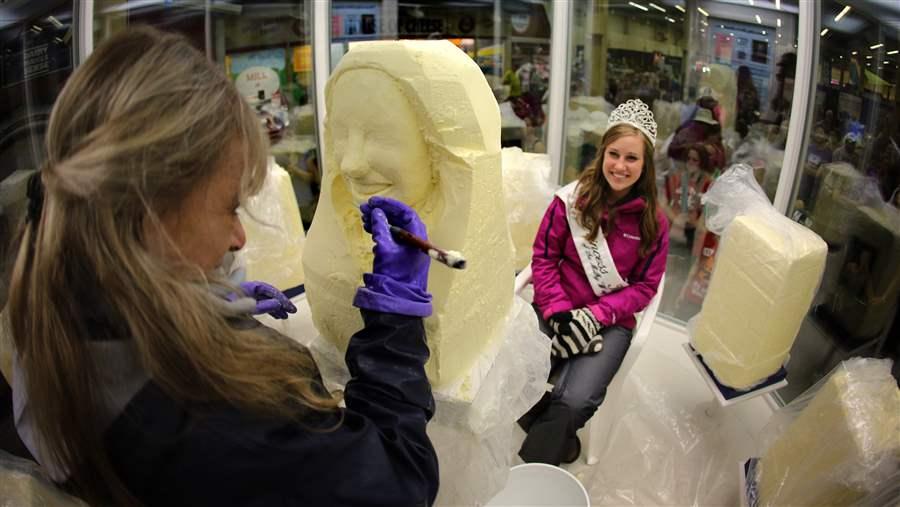
Crown© The Associated Press/The Star Tribune, Brian Mark Peterson
A sculptor works in the butter cooler at the Minnesota State Fair. To remain relevant, many states are adding drones, virtual reality attractions and craft beers to traditional agricultural offerings.
The Butter Cow, a life-size statue carved of pure cream Iowa butter, has drawn fans to the Iowa State Fair for more than a century. The 600-pound bovine packs enough butter for more than 19,000 slices of toast, and would take the average person two lifetimes to eat.
But 21st century fair goers expect something more: In addition to the cow and other traditional agricultural attractions, this year’s fair featured yoga and Zumba, craft beers and gluten-free corndogs.
To remain relevant, state fairs across the country — the latest ones will conclude this month — are going modern.
The California State Fair, for example, hosted the first U.S. National Drone Racing Championships, with 120 pilots competing for $25,000 in prizes. The drone races thrilled spectators, but they also showcased technology that can be used to monitor moisture and temperature in vineyards, track cattle and dust crops.
This year’s California fair also featured Tech Trek, an exhibit exploring how science fiction becomes science fact, with 3-D printing and robots. Also for the first time: an official fair chef. Keith Breedlove, a tattooed urban hipster and food truck entrepreneur, demonstrated cooking techniques.
In Washington, D.C., where cultivation of marijuana is now legal, the D.C. State Fair sponsored its first “Best Bud” competition, while the Indiana State Fair encouraged fairgoers to take and post a #farmerselfie with a different farm family every day of the fair. The New Mexico State Fair capitalized on the craft beer craze with an official New Mexico State Fair Beer. Organizers promoted the “tasty, cream ale” as “perfect for washing down fried foods from one of the many food vendors!”
“Two types of people come to our fair,” said Gary Slater, Iowa State Fair CEO. “Half don’t want us to change a thing, year after year. The other 50 percent say, ‘Been there, done that. Wow me somehow this year — or I won’t be back.’”

European Roots

Fairs seem quintessentially American, but settlers brought them from Europe and England. The York, Pennsylvania, fair celebrated its 250th anniversary this year. New York claims the first state fair, in 1841. About 150 million people go to fairs in the United States annually, said Jim Tucker, president of the International Association of Fairs and Expositions.
In some states, the fair attracts more people than any other event. That’s the case in Iowa, where more than 1 million people visit the state fair. The State Fair of Texas, which runs until Sunday, is the nation’s largest with nearly 2.9 million visitors last year. Other livestock shows and expos also draw huge crowds.
But they have changed.
“At one time, they were state fairs and states would pick up the tab,” said Doug Farquhar at the National Conference of State Legislatures. “States more and more lost patience with that payment model,” he said.
Most state fairs now are nonprofits that receive little or no state funds. They rely for their operating budgets on ticket sales, along with corporate sponsorships and revenue from vendors, carnival games and rides. Others receive state funds for capital improvements or for 4-H premiums, cash prizes awarded to young exhibitors in various competitions. A few, such as the Georgia State Fair, are run by for-profit companies.
The Minnesota State Fair, a 12-day, $50 million enterprise, is the nation’s second largest state fair and set an attendance record of more than 1.8 million ticketed visitors in 2014. This year, attendance was slightly less than 1.8 million. A study estimated the fair’s annual economic impact for the Twin Cities is $200 million.
“We don’t get a dime in state money and don’t want it. There are always strings,” said Jerry Hammer, general manager of the Minnesota State Fair “When the fate of an institution depends on political whims, it’s not a good situation.”
The entire extent of state financial support of the Virginia State Fair is $25,000 for 4-H premiums.
“There’s no handout, nor should there be,” said Marlene Pierson-Jolliffe, who oversees the State Fair of Virginia after spending nearly 25 years with the State Fair of West Virginia.
“Fairs have had to decide to apply solid business principles, get creative and aggressive,” she said. “It’s a tough business.”

Showcasing Products

But even as fairs have updated their attractions, their main mission has remained the same: showcasing state products, especially agricultural products. “At state fairs, among other things you meet the people who are feeding you,” said Minnesota’s Hammer. “That’s a good thing.”
This month’s North Carolina State Fair will showcase some of the state’s 160 wineries and 525 commercial grape growers with a State Fair Wine Competition. Winners will be displayed in the Education Building and North Carolina wines will be sold during the fair.   
At the Kentucky State Fair in August, amateur chefs entered their bourbon-laced entrees, soups, stews, barbecues and casseroles in the Evan Williams Kentucky Straight Bourbon Whiskey cooking contest. Top prize was $250 and the honor of being included in the company’s “Cooking with Bourbon” recipe booklet. 
Six New England state fairs are held together at the Big E (for “Exposition”) in West Springfield, Massachusetts. Each state builds a replica of its original statehouse where it exhibits and promotes state products.
This year, Big E attendees munched on Maine baked potatoes, sampled Vermont cheddar and sipped New Hampshire apple cider.
With less than 2 percent of Americans involved in farming, state fairs want to educate attendees about where food comes from.
“Our greatest challenge is to be relevant,” said Pierson-Jolliffe of Virginia. “Our ag education piece sets us apart from just going to a carnival in a parking lot.”

Wednesday, October 14, 2015

`The Martian' reminds that we're stuck on Earth -- Oct. 15, 2015 column

By MARSHA MERCER

To escape our earthly troubles, Americans are going to the movies to see plucky fictional astronaut Mark Watney, played by Matt Damon, struggle with problems that are, well, out of this world.

A box office bonanza for all the right reasons, “The Martian” is an entertaining adventure film that’s funny and thought-provoking.  No matter how bad our days are, we’ve never been left for dead by our colleagues on a hostile planet millions of miles from Earth. 

To set the stage: Watney gets stranded when a storm prompts the crew to make an emergency departure for Earth. He’s the only human and the only living creature on the entire planet. His supply of astronaut food will last only a couple of months, but a rescue, if it comes at all, will take years. To survive, he needs air, water and food in a barren world – and therein lies a tale.

The story is futuristic science fiction, but the movie bathes us in 1950s’ sensibilities. Wearing our 3D glasses, we bask in the glow of pride for Watney’s relentless determination and can-do spirit. He never falls into self-pity or depression.

“I’m going to have to science the (bleep) out of this,” he says cheerfully, in one of the movie’s most-quoted lines.  

With so much going wrong, just about the only thing he complains about is the disco music the mission’s commander left behind.  Oh, and when he runs out of ketchup. What a great American.
  
“The Martian” sends the message that smart is cool. Working hard is cool. Never giving up is not only cool but a matter of life and death. When was a botanist a cinematic hero -- or growing potatoes a major feat?

As we root for Watney and his ingenuity, we admire the dedication of his fellow crew members and NASA’s tireless staff. The country and the world rally around him. In the movie version of America, people work together, united in a cause greater than themselves. Even China wants to be helpful.

The real-life story of the novel on which the movie is based could itself be a movie. Software engineer Andy Weir wrote “The Martian” as a serial in 2009, posting the novel chapter by chapter on his blog. Readers asked for the book in one piece, and he put it on Amazon for 99 cents. It became a cult classic, Random House approached and “The Martian” hit the bestseller lists. Hollywood came calling. Fairy tales can come true.

Reports of salty water on Mars stir our imaginations, and “The Martian” could help NASA gin up support for a Mars mission in an era of flat budgets. When we sent a man to the moon in the 1960s, NASA’s budget peaked at 4.5 percent of federal spending; it’s less than half of 1 percent now.

Without more money, the Mars mission is grounded. The Obama administration is working on a Space Launch System and Orion manned crew vehicle, but NASA’s latest “Journey to Mars” report released Oct. 8 contained no budget, schedule or deadlines.

“It’s just some real pretty photographs and some nice words,” complained Rep. Lamar Smith, R-Tex., chairman of the House Science Committee at a hearing. “A journey to nowhere,” he said.
  
While there is bipartisan support on Capitol Hill for deep-space exploration, presidents come with different visions. President George W. Bush called for a lunar mission by 2020 leading to a trip to Mars. Barack Obama dropped the moon mission when it fell behind schedule in favor of an asteroid mission first, pushing back a crewed mission to orbit Mars to the mid-2030s.

In 1962, at the dawn of the Space Age, President John F. Kennedy said: “We choose to go to the moon and do the other things, not because they are easy, but because they are hard, because that goal will serve to organize and measure the best of our energies and skills, because that challenge is one that we are willing to accept, one we are unwilling to postpone.”

The atmosphere in Washington is too political and too toxic to expect much of anything soon. But the next president should galvanize the public and Congress behind the robust goal of a crewed mission to Mars with a date, budget and deadlines.

The space program has been a technological and emotional boon for generations of Americans and can be again. 

We need the shared national purpose and pride of reaching for the stars in real life – and not just at the movies.

 (C) Marsha Mercer. All rights reserved.
30


Thursday, October 8, 2015

Serving uncertainty: Pass the salt?

By MARSHA MERCER

Hello, whole milk, my old friend. Welcome back, eggs. Where you been, salt?  

The federal government is about to write new nutritional guidelines aimed at keeping Americans healthy. Whole milk soon may be back in our good graces, along with eggs and even salt. Unless they’re not.   

No wonder people are confused and peeved, if not angry.

The last thing anyone wants in nutrition rules is uncertainty. Why waste precious time deciding whether to buy a can of chicken noodle soup based on its milligrams of sodium if the science now says sodium is not a big deal? Our knowledge of  nutrition and health is constantly changing.

A headline on the front page of Wednesday’s Washington Post read: “A thinning case that fat causes heart ills – New studies vindicate whole milk as dietary advice is revised.” Uh-oh.    

We’ve been told for decades to substitute low- and non-fat milk for whole milk to prevent heart disease and other health problems. It turns out that whole milk may contribute less to heart trouble than the low-fat foods loaded with refined grains and sugar that we substitute for it.   

In other words, cookies and cakes, even the low-fat variety, are no solution.

Researchers found that people who included more milk fat in their diets actually suffered lower levels of heart disease than those who consumed less. And, no, the studies were not paid for by the dairy industry.

Cholesterol also isn’t the problem we once thought, so eggs, red meat and shrimp may no longer set off alarm sirens. We eat too much salt, but it may not be the culprit it seemed. And on top of all that, one study found that breakfast may not be the most important meal of the day.   

Naturally, people are frustrated. It’s tempting to throw federal Dietary Guidelines out with the skim milk.

“People may be losing confidence in the guidelines,” Rep. Collin Peterson, D-Minn., said Wednesday at a House Agriculture Committee hearing, adding that many of his constituents “don’t believe this stuff anymore. 

"They’re “flat out ignoring this stuff,” he said.

“Given the public’s skepticism, we should maybe reconsider why we are doing this,” Peterson said.

We are doing this because Congress in 1990 required that federal dietary guidelines be issued at least every five years. The guidelines set policy for everything from school lunches and other federal food programs to advice to individuals about what to eat to prevent such chronic conditions as heart disease, high blood pressure, type 2 diabetes, cancer and obesity.

Dietary Guidelines 2015 are due to be released by the end of the year.

An independent advisory committee that is helping the departments of Health and Human Services and Agriculture prepare the 2015 guidelines issued a massive report with several controversial recommendations. During the public comment period, about 29,000 comments were submitted – vastly more than five years ago.

Agriculture Secretary Tom Vilsack and HHS Secretary Sylvia Burwell said the committee’s report is not a draft of the new rules, which have not yet been written.

In a blog post this week previewing the new guidelines, Vilsack and Burwell said the new rules will look a lot like the old.  

“Fruits and vegetables, low-fat dairy, whole grains and lean meats and other proteins and limited amounts of saturated fats, added sugars and sodium remain the building blocks of a healthy lifestyle,” they said.  

Two recommendations by the advisory committee are definitely out. There will be no sustainability goals and no tax on sugary soft drinks, Vilsack and Burwell said. Sustainability refers to the environmental impact of food production. Meat and other producers that require a lot of water lobbied heavily against including sustainability in the guidelines. Soft-drink companies rallied against the tax.

Critics still will complain that the federal government shouldn’t tell us what to eat. Republicans criticize the “food police” as vociferously as health advocates complain about subsidies to sugar and corn. Conservatives want the National Academy of Sciences Food and Nutrition Board to review the guidelines before they’re released to the public. That could delay the process.

So, what should you do if you’re fed up with the government’s changing recommendations about good nutrition? The most practical advice may be: Get used to it. And, to be on the safe side, put the salt away.  

(C) 2015 Marsha Mercer. All rights reserved.

30

Wednesday, September 30, 2015

Old is new in partisan battle over Planned Parenthood -- Oct. 1, 2015 column

By MARSHA MERCER

Leave it to House Republicans to turn an accomplished executive making $520K a year into an underdog. 

After they forced out House Speaker John Boehner, who refused to shut down the government over funding for Planned Parenthood, conservatives turned their fire on the nonprofit’s president Cecile Richards. By attacking her personally, they made her an instant celebrity, a champion of high quality health care for poor women, and a hero to many.  

The government now has a lifeline until Dec. 11 and Planned Parenthood is still providing health care services with federal reimbursements. As for Richards, her marathon performance Tuesday before the House Oversight and Government Reform Committee showed why she earns the big bucks.

Bullied for more than five hours, she didn’t cave, get flustered or lash out. She calmly defended her organization. She kept her cool.

Which is more than you can say for members of Congress. They were as emotional as she was composed. Republicans were antagonistic and rude, Democrats apologetic and shocked, shocked.

Rep. Jim Jordan, R-Ohio, interrupted Richards 19 times in just five minutes. Rep. Diane Black, R-Tenn., a nurse, insisted that, “Abortion is not health care.”

Rep. Gerald Connolly, D-Va., said he hoped every American woman was watching the hearing.

“My colleagues say there’s no war on women. Look at how you’ve been treated as a witness -- intimidation, talking over, interrupting, cutting off sentences, criticizing you because of your salary. . . Lord almighty, what’s America coming to?”

Connolly railed about the “the disrespect, the misogyny rampant here today.”

But when Rep. John Duncan, R-Tenn., asked Richards if she should be treated differently than male witnesses who often face tough questioning, she responded in a flash:

“Absolutely not. That’s not how my mama raised me.”

Richards, 57, the daughter of the late Texas Gov. Ann Richards, is no stranger to toxic Washington. She worked years ago as a deputy staff director for House Democratic leader Nancy Pelosi. President of Planned Parenthood Federation of America since 2006, she has said, “We aim to be the largest kick-butt political organization.”

Senate Majority Leader Mitch McConnell, R-Ky., has said trying to “defund” Planned Parenthood is an “exercise in futility” with President Obama in the White House. For House Republicans, though, Planned Parenthood may be the new Obamacare – an object of disgust to be flogged and voted against repeatedly.

Rep. Martha Roby, R-Ala., led a symbolic effort to end funding Wednesday as the House passed the continuing resolution to keep the government open.

“I believe we have to fight until the very end,” she said.

Several committees are putting Planned Parenthood under a microscope, and Boehner agreed to create a select committee to investigate the nonprofit similar to the House Select Committee on Benghazi.

Republicans have battled Planned Parenthood for decades. It provides 327,000 abortions annually, and its separate political arm aids Democratic candidates.

In July, an undercover sting video surfaced, purporting to show Planned Parenthood officials cavalierly negotiating the sale of fetal tissue for research and discussing procedures to ensure intact fetal organs. Other disturbing videos followed.

Planned Parenthood says the videos were heavily and deceptively edited, and it denies any wrongdoing. Richards insisted that no federal funds are used for abortions except in the rare circumstances allowed under the law and that Planned Parenthood donates a small amount of fetal tissue to research in two states at the cost of its expenses.

About 2.7 million women and men a year, many of them low income, go to Planned Parenthood clinics for cancer screenings, birth control, tests and treatment for sexually transmitted diseases and other services.

Planned Parenthood receives $450 million annually in federal funds -- $390 million in Medicaid reimbursements for services provided, less than $1 million in child health and Medicare funds and $60 million from the National Family Planning Program, the nonpartisan Congressional Budget Office reported.

Critics contend taxpayers’ money could be better spent on cancer research.

Yet strong majorities of Americans support funding for Planned Parenthood, four separate polls by news organizations and the nonpartisan Pew Research Center reported this week.

“All women in this country deserve to have the same opportunities as members of Congress and their families for high quality and timely health care,” Cecile Richards said.

Her mama would have been proud.

©2015 Marsha Mercer. All rights reserved.

Thursday, September 24, 2015

Hurray for long presidential campaigns -- Sept. 24, 2015 column

By MARSHA MERCER

Brandishing poll numbers that still show him leading the Republican presidential pack, Donald Trump said in South Carolina Wednesday, “If we could call for the election tomorrow…Let’s do it! Do it tomorrow!”

In his dreams.

You can’t blame Trump for wanting the voting over already.  The Trump surge was the story of the summer, but there are signs it may have peaked. He still leads in the polls but isn’t gaining. His last debate performance was just OK. There are empty seats at some of his events. He’s thin-skinned about Fox News and conservative pundits. He bristles at questions about details of his plans.

Time is on the side of those who are waiting for Trump to self-destruct. His campaign of cuts – Carly Fiorina’s face, Hillary Clinton’s shrillness, Marco Rubio’s sweat – is bound to wear thin.

Democrats just hope he keeps talking. Every minute the media covers Trump or Pope Francis or anything else is time not spent on the troubles facing Hillary Clinton -- her own sinking poll numbers, the emails, trust, women, Bernie Sanders and maybe Joe Biden.

In a new book titled “Unlikeable – The Problem with Hillary,” former New York Times Magazine editor Ed Klein says Clinton suffers with headaches, insomnia and depression. A Clinton spokesman said Klein’s claims are bogus.

Our much-maligned, seemingly endless presidential campaign season does work: It gives candidates plenty of rope.  In four months – only four -- voters will start having their say. The dates could change, but the Iowa caucuses are now set for Feb. 1 and the New Hampshire primary Feb. 9.

A disadvantage of the long campaign is the tight focus on the horse race. We know that poll numbers are not predictive; they’re a snapshot. But they’re news.

Trump may be a natural at campaigning, but even hot air balloons eventually come down. Yes, some mainstream Republicans fear that he could be a latter-day Barry Goldwater, who captured the Republican presidential nomination in 1964 only to lose 44 states that November. But he also could be a Rick Perry in 2011 or Rudy Giuliani in 2007.

In September 2011, Texas Gov. Rick Perry was leading in the Republican presidential race. Four years earlier, former New York City mayor Rudy Giuliani looked unstoppable.  

Each election cycle is different, so we can’t rely on past performance as a guide. 
Former Florida Gov. Jeb Bush looked strong early, but he may be a Bush too far. The outsiders – Trump, retired pediatric neurosurgeon Ben Carson and former Hewlett-Packard CEO Fiorina – are big now, but will voters really choose another president who lacks experience governing?

The two 2016 Republican candidates who have left the stage – former Gov. Perry and Gov. Scott Walker of Wisconsin – actually had governing experience, a liability in this year of the anti-politician.  

Perry probably thought the statute of limitations had run out on his gaffe during a debate in November 2011 when he could not remember the third federal agency he would eliminate as president. It hadn’t.

Walker’s star faded as Trump’s rose. At 47, Walker could run again. He made his departure seem ordained.    

“I believe that I am being called to lead by helping to clear the field,” he told reporters. “I encourage other Republican presidential candidates to consider doing the same so that voters can focus on a limited number of candidates who can offer a positive, conservative alternative to the current front-runner.”

No one else seems so inclined. A Muslim civil liberties group urged Carson to give up his quest after he said that no Muslim should serve as president. He says he’s now raising money so fast it’s hard to handle it all. Carson since has retreated, saying he could support a Muslim president who put the Constitution before religion and rejected Sharia law.

The other GOP hopefuls are current and former governors and senators, able politicians who in most years would be contenders. Today they’re barely registering in the polls. But they’re hanging on, waiting and hoping that Trump’s train loses steam.    

The winnowing process has started and likely will last a while. We’ll all be better for the long, arduous, annoying way we choose our nominees for president. I’m just glad the election isn’t tomorrow.     

©2015 Marsha Mercer. All rights reserved.
30