Thursday, May 12, 2016

From STATELINE -- TB persists in the United States

http://bit.ly/1TB5SZ6

Is Tuberculosis Making a Comeback?
  • May 12, 2016
  •  
  • By Marsha Mercer
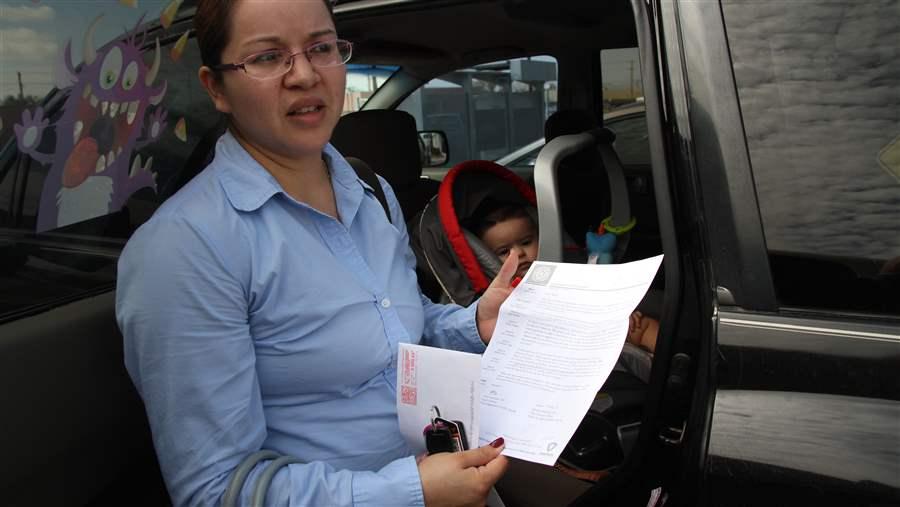
Letter from health authorities© The Associated Press
A woman shows a letter she received from health authorities saying her son was exposed to tuberculosis in a hospital in El Paso, Texas. State and local health departments are the front line of defense against a disease that may be on the upswing.
A year ago, Laura Hall felt tired all the time, was losing weight and had a bad cough.
The 41-year-old Spanish teacher from Shelburne, Vermont, went to doctors for three months before they finally nailed the diagnosis: active tuberculosis.
“I was scared. I was horrified. Oh my gosh, how did I get this? Where did I get it?” Hall said in a video about TB survivors’ experiences. “I didn’t think that I could get TB, ever.”
While Hall underwent treatment — isolation at home and a demanding regimen of antibiotics and other drugs — the Vermont Department of Health tested about 500 students and co-workers who might have been exposed to her. Nineteen children and two adults tested positive for latent TB. (People with latent TB aren’t sick or contagious, but they carry a greater lifetime risk of developing active TB.)
Hall’s was one of seven active cases in Vermont last year, up from two the year before. Twenty-nine states and the District of Columbia also reported more active TB cases last year than in 2014, the Centers for Disease Control and Prevention reported in March.
After two decades of steady decline, the number of active tuberculosis cases in the U.S. inched up last year. Hall’s was one of 9,563 TB cases reported last year, up from 9,406 cases the year before. The CDC is still trying to determine the reason for the uptick.
The goal set by the CDC, in 1989, of eliminating TB by 2010 — defined as less than one case in a million people — remains elusive. Even if the trend of declining cases had continued, the United States would not have eliminated TB by the end of this century, the CDC said.
“We are not yet certain why TB incidence has leveled off, but we do know it indicates the need for a new, expanded approach to TB elimination,” said Dr. Philip LoBue, director of the CDC’s Division of Tuberculosis Elimination, in an email.
A dual approach is needed: continue to find and treat cases of disease and evaluate their contacts as well as identify and evaluate other high-risk persons for latent TB infection, he said.
In Vermont, health officials aren’t sure whether last year’s increase was just a statistical anomaly or the beginning of a trend. In case it is the latter, the state Health Department is considering contracting with an outside firm to help it test contacts for exposure. Last year, the shorthanded department brought in health staff from around the state as well as volunteers from the Vermont Medical Reserve Corps to test contacts for exposure.
“We were lucky it wasn’t worse,” said Laura Ann Nicolai, deputy state epidemiologist and head of the tuberculosis control program.

Airborne Bacteria

TB is an airborne infectious disease caused by bacteria that spreads through the air, person to person, when someone coughs or sneezes. One in three people worldwide have latent TB, according to the World Health Organization. In the United States, up to 13 million people have been exposed to TB and could develop the disease.
Every year, tuberculosis claims 1.5 million lives worldwide and 500 to 600 in this country.
In the United States, Asians have the most cases and the highest rate of disease — 17.9 out of 100,000 persons. The top five countries of origin for foreign-born TB patients are Mexico, the Philippines, Vietnam, India and China.
Immigrants and refugees are screened for TB and treated before entering the United States. Tourists, students and temporary workers are not screened. The CDC does not recommend across-the-board screening for everyone entering the United States, the CDC’s LoBue said.
Because TB hits some ethnic and racial groups harder than others, TB patients can face discrimination and social isolation. Public health officials worry about finding ways to target high-risk populations with TB education and treatment without stigmatizing those groups.
“Given the stigmatization of TB, our ability to do targeted interactions is limited,” said Dr. Jeffrey Starke, a pediatric tuberculosis physician at Texas Children’s Hospital in Houston. Starke is a member of the federal Advisory Council for the Elimination of Tuberculosis, which makes policy recommendations. “We’ve got to find a nonpejorative way to do it so others don’t perceive discrimination,” he said.

Going in the Wrong Direction

State and local health departments are the front line of defense for a disease that many think has already been eradicated. In the late 1800s and early 1900s, TB was a leading cause of death in this country and Europe. With no cure for the disease, patients were urged to “go west.”
More people flocked to Colorado as TB patients looking for dry air and sun than stormed the state as prospectors during the gold rush. Among them: Doc Holliday, friends with gunslinger Wyatt Earp and a participant in the shootout at the O.K. Corral.
“Colorado historically has been on the forefront of TB work,” said Dr. Robert Belknap, director of the Denver Metro TB program. “At the turn of the century, one-third of the state was here because of TB — seeking care for themselves or family members,” he said.
Some of Colorado’s first hospitals were TB sanatoriums, later closed and repurposed. Local and state support for TB prevention and control remains strong in Colorado, said Belknap, president of the National Tuberculosis Controllers Association.
Today four states — California, New York, Texas and Florida — have more than half the nation’s active TB cases, though they have only a third of the country’s population. The four states have the highest numbers of foreign-born residents. The number of cases in Texas rose 5 percent to 1,334 last year.
“We’re clearly going in the wrong direction,” Starke said.
He pointed out that TB is “a social disease with medical implications” because living conditions put someone at risk. TB is associated with poverty, overcrowding and being born outside the United States.
California, with 2,137 cases in 2015, has more than one in five of the new U.S. cases each year and a TB rate nearly twice the national average. Its TB prevention and control program is the nation’s largest — a $17.2 million annual budget split roughly in half between federal and state general funds, and a 40-person central office staff that works with TB contacts in the state’s 61 local health jurisdictions.
In addition to state TB control efforts in California, local health department programs in the counties of Los Angeles, San Diego and San Francisco also receive federal TB control grants from the CDC. Those grants total $7.7 million this year.
About 2.5 million people are infected with TB in California, but most don’t know it, said Dr. Jennifer Flood, chief of California’s TB control program.
While California has several programs aimed at latent TB, she said, “Smaller states are often challenged to test and treat latent TB” because they lack the resources.

Labor Intensive Treatment

Treating TB patients is labor intensive. To ensure that TB patients complete the course of drugs that lasts six months or longer, Directly Observed Therapy programs require a health care worker — not a family member — to watch patients with active TB swallow every dose. If a patient cannot get to a clinic, a health care worker goes to the person’s home. The worker monitors patients for side effects and other problems.
Care also involves communication and cultural challenges. In Michigan, where the number of active TB cases rose from 105 in 2014 to 130 last year, the health department reaches out to Detroit’s large Arab and Bangladeshi populations. In other parts of the state, Burmese immigrants have different needs, said Peter Davidson, Michigan TB control manager.
“Some local health departments have strong partnerships with translation services. Some rely on a less formal mechanism — a private physician or someone on staff at the hospital who speaks the language,” Davidson said.
The cost of treating an active TB case that is susceptible or responsive to drugs averages $17,000, according to the CDC. Care of patients with drug-resistant TB, which can result from taking antibiotics prescribed before TB was properly diagnosed, costs many times more: $134,000 for a multidrug-resistant patient and $430,000 for an extensively drug-resistant one.
Advocates say TB suffers from a lack of urgency and funding.
“TB isn’t as exciting a topic because it’s been around so long. It doesn’t get as much attention as Ebola and Zika, and its advocates aren’t as active as those for HIV/AIDS,” said Belknap. “We’re jealous.”
The federal Tuberculosis Elimination Act, the chief federal funding for TB programs, is authorized at $243 million a year but has received an appropriation of far less for the last several years — $142 million this year, for example.
Most of the money goes to the 50 states, the District of Columbia, 10 major cities and eight territories in grants under a formula based on the number of cases, their severity and other factors. The grants are used to pay salaries for nurses, doctors and epidemiologists, as well as for education and outreach services. Treatment costs are paid by insurance, Medicaid and state and local governments.
Funding at the authorized level could support research on a vaccine and better drugs and treatment of more cases of latent TB, advocates say. For now, no TB vaccine is approved for use in the United States. The medicines that cure TB and brought down the disease rate were developed in the mid-20th century. They require months of treatment and can have serious side effects, including hearing loss. A promising new drug may be able to prevent TB with only 12 doses over three months.
“The tools we have are inadequate,” Belknap said. “It’s a federal and a global problem.”

A Story of Success

In many ways, though, the story of TB prevention and treatment in the United States is one of success.
“We often say we’re our own worst enemy,” said Donna Wegener, executive director of the National TB Controllers Association. “We had such success in reducing TB after the resurgence in the 1990s that people think we don’t need additional dollars.”
Patients with diabetes, cancer and especially HIV infection are more likely to contract active TB because their immune systems are less able to fight off TB germs. During the HIV/AIDs epidemic, from the mid-1980s to the early 1990s, the number of TB cases jumped by 19 percent. From 1992 to 2014, the number of cases dropped 65 percent.
There were nearly as many cases of Lyme disease in Pennsylvania in 2014 (7,457) as there were TB cases in the United States (9,406).
But, Wegener said, “If we were reporting 10,000 new cases of polio a year in the U.S., that would be unacceptable. It’s criminal that we are OK with 10,000 cases of TB.”
Among those infected in the early 1990s was a young physician who volunteered to treat TB patients at a clinic in New York City. He tested positive for exposure but his latent TB did not progress to active disease. Tom Frieden now is director of the CDC, leading the fight against TB.

'Healthy' and 'natural' with a side of skepticism -- May 12, 2016 column

By MARSHA MERCER

After hiking in a beautiful Virginia state park last weekend, friends gathered around a picnic table. As we unpacked our lunches -- virtuous sandwiches on whole wheat and righteous chips of kale and quinoa -- Doug pulled out a bag of trail mix.

“Healthy,” the bag proclaimed in big print. Doug read the small print and frowned.

“How can this be healthy?” he demanded. “It’s got chocolate in it.”

No worries, his pals said. Chocolate is now OK – dark chocolate, anyway. Doug was unconvinced.

“Anybody want chocolate?” he asked.

We’ve all had that moment of feeling misled upon reading the fine print on an ingredient label. What we grabbed off the store shelf, lured by the promise of “healthy” or “natural,” turned out to be loaded with sugar or additives.

The Food and Drug Administration announced Tuesday it will review the definition of “healthy”; it’s already examining what it means to be “natural.”

The process of formulating new rules takes years. So we consumers need to accept the things we cannot change. Think of claims on packaged foods as puffery. Period.

The criteria the FDA uses to judge what’s “healthy” are antiquated. Under guidelines first adopted in the 1990s, canned soups, fat-free puddings and sugary cereals qualify, but not plain almonds, avocado and salmon.

This craziness happened because back then fat was Public Enemy No. 1. 

To be "healthy," a food could have 1 gram or less of saturated fat per serving and no more than 15 percent of calories from saturated fat. It also had to meet criteria in sodium, cholesterol and nutrients such as calcium and vitamin C. Sugar wasn’t even considered. Food science has moved on, and we now know there are good fats, like those in nuts and salmon.

In March 2015, the FDA sent Kind LLC a warning letter, saying it had to stop using the word “healthy” on four of its popular fruit-and-nut bars because the products had too much fat.

Kind fought back, filing a citizen petition with FDA, arguing that the agency should have rules that are consistent with current nutrition science as set forth in the 2010 Dietary Guidelines. Last month, FDA agreed and said Kind could use “healthy and tasty” on its packages as the agency reviews the definition.
 
The kerfuffle was great publicity for Kind, which had to change none of its ingredients. CEO and founder Daniel Lubetzky praised FDA for being “very, very open to listening” and for beginning the conversation to update the rules.

Here’s how Marion Nestle, New York University food science and nutrition professor and author of “Food Politics: How the Food Industry Influences Nutrition and Health,” assessed the situation on her Food Politics blog:

 “The terms `healthy’ and `natural’ help to sell food products. They are about marketing, not health. This makes life difficult for the FDA, which has the unenviable job of defining what the terms mean on food labels.”

Until the 1980s, companies were prohibited from touting foods as a possible way to reduce disease. In 1984, the Kellogg Company, maker of All-Bran cereal, and the National Cancer Institute began spreading the word that a low-fat, high-fiber diet could help reduce the risk of colon cancer. The FDA did not object because the statement was true, Clare M. Haskel wrote in the Journal of Nutrition.

Soon, though, unsubstantiated health claims flooded the market, and in 1989 Business Week magazine ran a cover story, “Health Claims for Foods are Becoming Ridiculous.” Congress passed the Nutrition Labeling and Nutrition Act of 1990, which allows health claims only with FDA approval.

FDA created a system for evaluating foods and has tried to keep consumers informed, but the messages are often confusing.

Chocolate, for example, has been shown in some studies to have antioxidant potential and may lower cholesterol, but its high calorie, sugar and fat content can lead to tooth decay and obesity.

Hardly a day passes without new guidance about what to eat -- or avoid eating -- to stay healthy. The ever-changing advice is frustrating, but one thing is clear:


“When it comes to food labels, `healthy’ and `natural’ are marketing terms,” says Nestle. “Their purpose is to sell food products. Caveat emptor.” 

(c)2016 Marsha Mercer. All rights reserved.

Thursday, May 5, 2016

Hillary meets coal reality -- May 5, 2016 column

By MARSHA MERCER

When Hillary Clinton went to coal country Monday, she ran smack into a wall of anger – and it wasn’t built by Donald J. Trump.

Clinton built it herself, word by word.

Like most politicians, Clinton tries to please everyone all the time, tuning her pitch to different audiences. Once in a while, though, real life intervenes, as it did in Williamson, West Virginia. 

While hundreds of protesters outside shouted “We want Trump” and “Go home, Hillary,” Clinton talked with local people, among them Bo Copley, a 39-year-old father of three who recently lost his job as a coal mine foreman and maintenance planner.

Copley handed Clinton a picture of his family and quietly asked:   

“How can you say you’re going to put a lot of coal miners out of jobs and then come in here and tell us how you’re going to be our friend? Because those people out there don’t see you as a friend.”

In March at a CNN town hall in Ohio, Clinton had said, “We’re going to put a lot of coal miners and coal companies out of business.” Understandably, many in coal country are still livid.

“What I said was totally out of context with what I meant,” Clinton said in Williamson, blaming herself for her “misstatement.”

Clinton’s views on coal and climate change matter because West Virginia’s primary is Tuesday.

Before he wrapped up the Republican nomination, Trump won many hearts with promises to end President Barack Obama’s “war on coal” and bring back the coal industry and coal jobs.

Politicians have been talking about helping Appalachia since John F. Kennedy traversed West Virginia in 1960, but the region still struggles. Clean energy may be America’s future, but, as Copley reminded Clinton, real people are suffering in the transition.

In 2008, Clinton sailed to victory over Obama in the West Virginia primary. Now, Bernie Sanders, who continues his uphill fight for the Democratic nomination, leads her 45 percent to 37 percent in the state, with 18 percent of voters undecided, a Public Policy Polling survey released Tuesday found.

Clinton was narrowly ahead among Democrats, but Sanders held a commanding advantage among independents. Independents – about 20 percent of the state’s electorate -- can vote in either primary.

How Clinton came to eat her words reflects a risk politicians face when trying to be all things to all people.

Asked in March to make her case to poor whites who vote Republican, Clinton said she was the only candidate with a plan to bring economic opportunity to coal country with clean renewable energy after coal miners and companies were out of business.

She talked about uniting the country but referred to miners as “those people.”

“We’re going to make it clear that we don’t want to forget those people. Those people labored in those mines for generations, losing their health, often losing their lives to turn out our lights and power our factories.

“Now we’ve got to move away from coal and all the other fossil fuels, but I don’t want to move away from the people who did the best they could to produce the energy that we relied on,” she said then.

Clinton wants to expand President Obama’s Clean Power Plan, tough new Environmental Protection Agency regulations aimed at curbing coal consumption. The Supreme Court has put the regs on hold, pending review.

Her $30 billion plan to revitalize coal country includes preserving miners’ pensions and benefits and spending more money for roads and bridges and economic development.

She even says she’ll bring her husband out of retirement and put him in charge of helping coal country. Bill Clinton won West Virginia in the 1992 and 1996 general elections – something no Democratic presidential nominee has done since.

But times have changed. The former president was booed and heckled May 1, in Logan, W.Va.

“I came here to tell you that I care about what you’re going through,” he said. “I get it.”

Tuesday’s vote will be a test of the old Clinton magic.

The Facebook page for the West Virginia for Bernie Sanders group invites Hillary Clinton’s supporters to join, saying: “We’ve been waiting for you.”


©2016 Marsha Mercer. All rights reserved.

Thursday, April 28, 2016

Running mate's new role: attack and cuddle -- April 28, 2016 column

By MARSHA MERCER
Carly Fiorina may be the best thing to happen to Ted Cruz since Dr. Seuss.
In 2013, Cruz, an obscure senator with dreams of the White House, staged a talkathon on the Senate floor against funding the Affordable Care Act, or Obamacare. During the 21-hour theatrical performance, he read the good doctor’s “Green Eggs and Ham” to his little girls as a bedtime story.
The stunt gained Cruz the national attention he craved among conservatives – and the enmity of fellow senators.
Now, hoping to revive his flagging campaign, Cruz has named Fiorina – his former rival for the Republican presidential nomination and former CEO of Hewlett-Packard -- as his running mate. After losing a string of contests to Donald J. Trump, Cruz hopes this unorthodox move will help him win Tuesday’s primary in Indiana.
Cruz in essence is asking voters to give him a second look in this Year of the Woman’s Card. Even if you don’t like me, he seemed to say Wednesday in Indianapolis, you’ll like her and then maybe you’ll like us enough.  
Fiorina, an adept public speaker, previewed her role in the campaign. She blasted Trump and Hillary Clinton as “two sides of the same coin” and “part of the system,” and she shared a snippet of a made-up song she sings with Cruz’s daughters, ages 8 and 5, on the campaign bus.
“I know two girls that I just adore. I’m so happy I can see them more,” Fiorina sang.
In the past, humanizing a candidate was a job for a candidate’s wife. Attacking the opposition was the VP’s role. Fiorina showed she can punch – and cuddle. That’s a first.
She also could be helpful in California, where she has ties and ran unsuccessfully for the U.S. Senate in 2010. But her home is in Virginia. In 2011, she and her husband Frank bought a $6.1 million mansion on five acres with sweeping views of the Potomac in a gated community in Lorton.
Choosing a running mate used to be almost an after-thought, but that’s changed in recent years. Cruz’s early pick suggests the choice may be especially important this year.
The election is shaping up as a contest between two of the most unloved and distrusted people in America, Trump and Clinton. An appealing running mate could conceivably sway some none-of-the-above people to go to the polls.
So, besides geography, gender, age, ethnicity, ferocity, the wow factor and, yes, even qualifications to step in as president, a running mate’s favorability or comfort level with voters is a factor.
For example, if Trump were to pick John Kasich, someone who actually has experience in Washington, the choice might make Trump less scary to moderate Republicans and dubious independents who lean toward the GOP. Might.
Kasich has said, as he must at this point, that he’s not interested in being anyone’s VP and is developing his own list of running mates. 
Trump has said he won’t announce his choice until he actually wraps up the nomination. But he is dropping tantalizing hints. When a supporter, South Carolina Lt. Gov. Andre Bauer, mentioned on CNN Oklahoma Gov. Mary Fallin as a possibility, Trump tweeted: “Great job and advice.”
If the election came down to Trump and Clinton in Virginia, some Bernie Sanders supporters and independents leaning Democratic might hold their noses and vote for Clinton if one of their senators, Tim Kaine or Mark Warner, was at her side.
“Kaine is Able, and Warner is Too,” read a headline in National Review a year ago.
Another hot Democratic prospect, with an eye to the Hispanic vote, is Julian Castro, secretary of Housing and Urban Development and a former mayor of San Antonio, Texas. But a Clinton ally once told Politico that Tim Kaine speaks better Spanish than Castro.
While Sanders is laying off staff, Clinton has set her campaign on vetting VP candidates.
“She has told her team she cares less about ideology and personal compatibility than about picking a winner, someone who can dominate the vice-presidential debate and convince Americans that Mrs. Clinton is their best choice,” Patrick Healy of The New York Times reports.
That’s the bottom line: It’s all about winning, and who can help the most.
© 2016 Marsha Mercer. All rights reserved.

30

Thursday, April 21, 2016

GOP could party like it's 1952 -- April 21, 2016 column

By MARSHA MERCER

Donald J. Trump, having vanquished apathy, has set his sights on ennui. He wants to save us from another boring Republican National Convention.

The GOP confab in 2012 was “the single most boring convention I’ve ever seen,” said Trump.

“It’s very important to put some showbiz into a convention; otherwise people are going to fall asleep,” he told The Washington Post.

Even actor and director Clint Eastwood couldn’t rescue Mitt Romney’s convention four years ago. Eastwood’s rambling conversation with an empty stool as if President Barack Obama sat there was simply odd.

Whatever Trump has in mind, the proceedings in Cleveland in July to pick the Republican presidential nominee likely will be anything but a snooze fest.

Trump claims he’ll have the 1,237 delegates needed for nomination, but the Dump Trump movement is still kicking, despite a setback in New York on Tuesday. Trump insists that, if he falls short of the magic number, fairness demands that he be the nominee, because he has won millions more votes than his rivals.

His rivals are just as insistent that they should win. With the delegate math against Ted Cruz and John Kasich, though, much depends on the rules, which the convention’s Rules Committee will draft ahead of time. A majority of delegates must ratify them.

Like him or not, Trump is brilliant at using media – old and new -- to his advantage.

“My famous line `I’m the only one that BEAT Ted’ updated from 21 times to 22 times!” he tweeted after the New York primary.

He became a household name a dozen years ago with his reality TV show, “The Apprentice.” He tweets constantly and has 7.6 million Twitter followers. He dominates the news and hardly needs to buy ads because he gets his message out free.

Since many people now get their news through social media, instant reactions to how the GOP settles on a nominee could affect attitudes about the party going into the fall campaign.

For clues, we can look to 1952 and the dawn of television, when Republicans had a seriously contested convention.

When Republicans met in Chicago in July 1952, the race between “Mr. Republican” Sen. Robert A. Taft of Ohio and World War II hero Gen. Dwight D. Eisenhower was neck-and-neck.

Eisenhower’s forces appealed to fairness. They accused Taft of stealing delegates and challenged the credentials of delegations from Georgia, Louisiana and Texas.

Eisenhower’s delegates ultimately were seated. Ike won the nomination on the first ballot and swept to victory in November over Democrat Adlai Stevenson.

The 1952 nominating conventions were the first TV covered on a large scale. On camera, the politicians in the Gold Room of the Congress Hotel played up to the people back home. They made their deals in a smoke-filled kitchen that was off limits to TV. Here’s how a young newspaperman reported it:

“In calmer days, the Gold Room is a banquet hall…But today the Gold Room was a political arena from which television was showing millions of Americans a bitter struggle for control of the National Convention,” wrote Charles McDowell of the Richmond Times-Dispatch.

When he arrived at the Gold Room, “no seats were available for junior reporters from the provinces,” he recalled later. A kindly security guard let McDowell slip into the kitchen. The pols thought the reporter was a hotel functionary, he said.

 In “the huge tiled kitchen, with its racks of glasses, stainless steel sinks and signs saying `Keep it Clean,’” McDowell saw what TV missed – the horse-trading that preceded the action on the convention floor.

People at home saw Eisenhower as “a national hero standing above politics and demanding simple justice from the cynical bosses of what had always been a closed process,” McDowell wrote later. The people’s reaction was swift.

“The telephone calls and telegrams poured into Chicago; the feedback was pro-Eisenhower,” McDowell wrote
.
Just imagine the tsunami of tweets and texts – our era’s telegrams and calls -- if Trump doesn’t get his way at this convention.

Showbiz? We won’t need it as long as Trump’s in the show. Nobody will snooze.

©2016 Marsha Mercer. All rights reserved.

Thursday, April 14, 2016

Stopping Zika one bucket at a time -- April 14, 2016 column

By MARSHA MERCER
Congressional Republicans are balking at President Barack Obama’s request for $1.9 billion in emergency funds to prevent and treat the Zika virus, which is transmitted by mosquitoes. Why the reluctance?
“They haven’t been bitten yet,” said Sen. Barbara Mikulski of Maryland, top Democrat on the Appropriations Committee.
Zing!
It’s politics as usual in Washington. Republicans said the administration should use already allocated funds, so Obama shifted $510 million from the fight against Ebola in West Africa and $79 million from diseases like malaria and tuberculosis to Zika.
But that’s not enough, said Dr. Anthony Fauci, director of the National Institute of Allergy and Infectious Diseases at the National Institutes of Health, who’s holding out for the full $1.9 billion.
“I’m not an alarmist,” Fauci told reporters Monday, “but the more we learn about the neurological aspects (of Zika), the more we look around and say, `This is very serious.’”
The nation’s top docs say the Zika threat is “scarier” than initially thought. Zika causes severe birth defects in newborns and is linked in adults to Guillain-Barre syndrome, an immune system disorder, said the Centers for Disease Control.
So far, no mosquitoes have transmitted the virus in the United States, although officials say that could change this summer.  
The 346 Zika cases reported in 40 states are all travel-related. Florida has the most with 85 cases. In Virginia, nine cases have been reported. Tennessee has had two cases, and Alabama, one.
In Puerto Rico, where mosquitoes are spreading the virus, hundreds of thousands of cases are expected this year. The government is distributing Zika prevention kits there and in other hard-hit areas.
There’s hope for a vaccine, with trials possibly starting in September. Obama is expected to sign into law a measure providing incentives to pharmaceutical companies to develop Zika treatments.
Once again, though, neither the White House nor Congress has thought to enlist ordinary Americans in fighting the threat. After 9/11 when the government mobilized for the war on terror, leaders asked nothing of most people. About 1 percent of Americans volunteered for war; the rest were told to go shopping. 
With Zika, the government is asking women who are pregnant or plan to be not to travel to affected areas.
But if we ever we needed a common enemy to draw us together, it’s now. Americans may be poles apart politically, but it’s safe to say nobody likes mosquitoes. Even before Zika, mosquitoes brought us West Nile Virus, and still do. To them, we’re just a meal.
Officials say Aedes aegypti, a.k.a. yellow fever mosquito, is most likely to transmit Zika. It has been found in 30 states, including throughout the Southeast. Until its tie with Zika, this mosquito was known for causing more casualties in the Spanish-American War than combat.
So, what’s a patriot to do in the undeclared war on mosquitoes? I stopped by the Arlington County (Va.) Cooperative Extension Service office and learned more about mosquitoes than I knew to ask.
For example, only the female mosquito bites. She needs a blood meal to lay eggs. The Aedes aegypti deposits hundreds of them on wet container walls or near standing water. Even if the surface is dry, the eggs can hang on for months. When water reappears, they hatch and grow to full-grown in a week.
Chemical insecticides often kill the beneficial insects along with the pests and can be bad for pets and pond fish. So, before you hire an exterminator, have a “dump the bucket” party in your neighborhood. Empty cans, flower pots and birdbaths weekly.
Get rid of old tires. Put goldfish in your pond to eat mosquito larvae or use larvicide donuts. Check gutters and downspouts to be sure they are free flowing and don’t hold water. Repair window screens.
When possible, wear long sleeves and long pants. Use products containing DEET, picaridin or oil of lemon eucalyptus on exposed skin – but not under clothes. Follow the label instructions.
And listen to Mikulski: “The mosquitoes are coming. You can’t build a wall to keep them out, and the mosquitoes can’t pay for it.”
But we can join our neighbors and dump the bucket. Early and often.
©2016 Marsha Mercer. All rights reserved.

30

Thursday, April 7, 2016

If only the 2016 campaign could rise to poetry -- April 7, 2016 column

By MARSHA MERCER

It’s National Poetry Month, so let us praise politicians who campaign in poetry in 2016.

Anyone . . . Anyone?

In the 1980s, Mario Cuomo could say without irony: “You campaign in poetry; you govern in prose.”

Obviously, Cuomo couldn’t have imagined today’s presidential contest when he made the distinction between the lofty words that inspire voters and the gritty compromises needed to make policy.

In January, the prospects for poetry in the campaign looked promising. When Bernie Sanders launched his brilliant ad using Simon and Garfunkel’s “America,” Hillary Clinton said she loved it.

“We need a lot more poetry in this campaign and in our country,” she told Chris Cuomo of CNN at a Democratic town hall in Iowa. “So I applaud that. I love the feeling. I love the energy.”

The feel-good feeling didn’t last. The campaign soon devolved from poetry to a coarse limerick.

Rare in 2016 is the presidential candidate who appeals to what Lincoln called the better angels of our nature. Two exceptions: Democrat Martin O’Malley, who was given to recitations of Irish poetry, and Republican John Kasich, who stays more cheerful than combative in a campaign marked by insults, anger and ridicule.

We know how far quoting Eavan Boland by heart took O’Malley. We’ll see whether Kasich can parlay civility and thoughtfulness into anything higher than third place. Donald J. Trump’s wordsmithing begins and ends with taunts --“Lyin’ Ted,” meet “Low-energy Jeb.”

It wasn’t always like this.

“Our nation’s first great politicians were also among the nation’s first great writers and scholars,” then-Sen. John F. Kennedy recounted in a 1956 commencement address at Harvard, his alma mater. “Books were their tools, not their enemies.” He himself won the Pulitzer Prize for biography in 1957 for “Profiles in Courage.”

Americans’ appreciation for poetry is reflected in the fact that 42 states and the federal government have poets laureate.

The Virginia state Senate in February invited Virginia poet laureate James Ronald Smith, who teaches at St. Christopher’s School in Richmond, to read a poem on the Senate floor.

Margaret Britton Vaughn received a lifetime appointment as Tennessee’s poet laureate in 1996. Alabama poet laureate Andrew Glaze died in February at the age of 95.

The term of the U.S. poet laureate Juan Felipe Herrera ends in May. Several presidents, starting with JFK, have invited poets to read at their inaugurations.

We celebrate National Poetry Month because the American Academy of Poets decided in 1996 that poetry should have its own month the way black history and women’s history do. It’s grown into the largest literary celebration in the world, the academy says.

At a poetry month celebration at the White House last April, President Barack Obama said: “The greatness of a country is not just the size of its military, or the size of its economy, or how much territory it controls. It’s also measured by the richness of its culture.”

And, Obama said, “If you want to understand America, then you better read some Walt Whitman. If you want to understand America, you need to know Langston Hughes.”

The Library of Congress website has a Presidents as Poets area with information on eight presidents who wrote poetry at some point in their lives, starting with George Washington’s “anguished love poems,” through Obama. Obama had two poems published in the literary magazine at Occidental College when he was an undergraduate.

Asked by The New Yorker in 2007 to evaluate Obama’s work, the estimable Yale literary critic Harold Bloom said one poem was “not bad – a good enough folk poem with some pathos and humor and affection.”

Bloom was less charitable toward published poet Jimmy Carter, calling him, “literally the worst poet in the United States.”

In his 1956 commencement speech, JFK told a story about an English mother who wrote her son’s school: “Don’t teach my boy poetry; he is going to stand for Parliament.”

“Well, perhaps she was right,” Kennedy said, “but if more politicians knew poetry, and more poets knew politics, I am convinced the world would be a little better place to live.”

I agree, but we need not wait for the politicians. April 21 is Poem in Your Pocket Day, when people find a poem they love and carry it with them to share. What’s yours?

©2016 Marsha Mercer. All rights reserved.
30